
Yuh Siang Garden · Bukit Timah · Est. 1972 Field Notes from the Curators
Premium Fragrance Manufacturing: The Documents That Back a Compliant Line
A premium fragrance line is a promise that has to be proven three times: to the buyer, to the retailer and to the regulator. The proof is a document set — IFRA compliance for the concentrate, a safety assessment, the product information file, market notification, batch records and stability reports — and every one of those files is produced on a schedule you should see before production, not after. The brands that survive contact with a market are not the ones with the most beautiful scent; they are the ones with the complete file.
Key takeaways
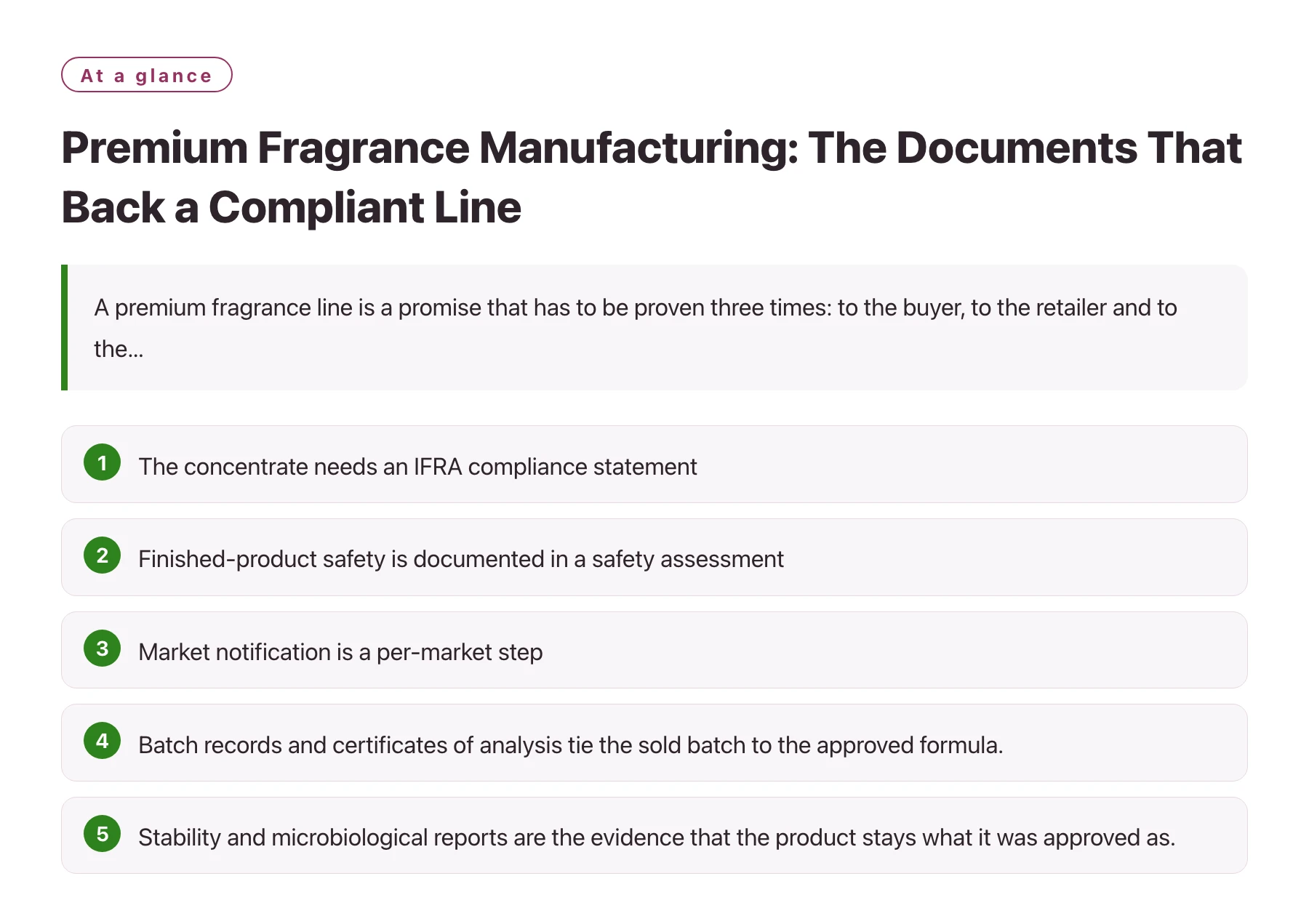
- The concentrate needs an IFRA compliance statement, because fragrance ingredients are restricted and the formula has to prove it works inside the current limits.
- Finished-product safety is documented in a safety assessment, which the EU route requires as part of the product information file.
- Market notification is a per-market step, and it happens before sale, not after.
- Batch records and certificates of analysis tie the sold batch to the approved formula.
- Stability and microbiological reports are the evidence that the product stays what it was approved as.
Premium pricing raises the expectation of evidence, not the standard of it. The document list for a luxury line is the same as for a drugstore scent in most markets — what changes is how carefully the market, and your retail partner, will read it.
The problem is not that the documents are hard to get; it is that they are produced by different parties on different schedules, and a first-time brand usually discovers one of them is missing at the worst moment.
This article maps the document set and, just as importantly, who produces each file and when it needs to exist.
Why premium lines carry more paperwork, not less
A cheaper product can sometimes pass with a thinner file because nobody inspects it twice. A premium product is inspected by the buyer's nose, the retailer's compliance team and the regulator alike, so the file has to be complete, consistent and dated.
The good news is that manufacturers who target export markets are used to producing the pack. The positioning of a premium manufacturer should come with the concrete framework beneath it: Xuelei high-end fragrance manufacturer, for example, publishes the certification framework it works to, so the buyer's first compliance step is comparing claims against published documents Xuelei high-end fragrance manufacturer.
The habit of opening the file at the first sample rather than the first shipment is what separates lines that launch from lines that stall.
The document set, from formula to shelf
| Document | What it shows | When it matters |
|---|---|---|
| IFRA compliance statement | The concentrate works inside ingredient restrictions | Before the formulation is locked |
| Allergen declaration | Named allergens at or above labelling thresholds | At label design |
| Safety assessment | The finished product is safe for its intended use | Before market entry |
| Product information file and notification | The EU responsible-person and notification record | Before the product is placed on the market |
| Batch record and certificate of analysis | The sold batch matches the approved formula | At every shipment |
| Stability and microbiological reports | The product stays within specification over time | At release and after market entry |
Two rows decide whether a launch happens on schedule: the safety assessment and the notification. Everything else can be patched; those two cannot.
Who produces each document
The factory
The factory owns the concentrate documentation: the IFRA compliance statement for the formula, batch records, certificates of analysis, and the stability and microbiological testing performed on its own batches. Safety testing in perfume manufacturing is a production stage, not an add-on you outsource to the retailer safety testing in perfume manufacturing.
Most of this is visible before a visit: a manufacturer's about page covers its background and certifications, which is where you cross-check the claims made on the sales call its background and certifications.
The brand, as responsible person
The brand owns the market-facing steps: appointing the responsible person where the law requires one, compiling the product information file, submitting notifications, and keeping the file updated as the formula or the packaging changes. In the EU these duties sit on the responsible person, and the European Commission's cosmetics pages set out the rules plainly [1].
Independent assessors and committees
Safety assessments are written by qualified safety assessors, drawing on scientific opinions — including those on fragrance allergens — issued by bodies such as the EU's scientific committee on consumer safety [2]. The ingredient restrictions themselves sit in public references such as the IFRA standards library and, for the EU, the commission's ingredient database, so the substance behind every claim is checkable [3].
Markets beyond the EU
The same pattern repeats in most regulated markets: one product file, several submissions. Canada, for example, runs its own cosmetics notification system and maintains a national ingredient hotlist, so a line sold there needs an extra submission before it can be offered [4]. Map the submission calendar for every market in the plan, because each one has a deadline that sits before the on-sale date.
Keep one product file per scent: formula reference, retained samples, IFRA statement, safety assessment, notification records, batch records and stability reports. A premium line without that file is a premium claim without evidence — and the evidence is exactly what the second order, the first retailer and the market inspector will ask for.
Sources
- European Commission: Cosmetics in the EU —— The European Commission's overview of EU cosmetics rules, including the responsible person, product information file and safety report requirements.
- EU Scientific Committee on Consumer Safety (SCCS) —— The EU scientific committee that issues opinions on the safety of cosmetic ingredients, including fragrance allergens and their labelling thresholds.
- IFRA Standards Library (International Fragrance Association) —— The IFRA Standards Library lists the restrictions the fragrance industry applies to individual fragrance ingredients, based on safety assessments; it is the reference point for compliant fragrance formulation.
- Health Canada: Cosmetic Safety —— Health Canada's cosmetics pages, covering cosmetic notification, the ingredient hotlist and safety requirements for cosmetics sold in Canada.
Frequently asked questions
Does a premium fragrance need more compliance documents than a regular one?
The legal list is the same; the scrutiny is different. Retailers and markets read the file of a premium product more carefully, so completeness matters more, but the documents themselves are the standard set.
Who is responsible for compliance — the factory or the brand?
Both, in different parts. The factory documents the concentrate and the batches; the brand owns market-facing duties such as the responsible person, the product information file and notifications. The division should be written into the agreement.
When is the latest I can prepare the compliance documents?
The safety assessment and notification must be complete before the product is placed on the market, which means before you hold stock, not after. The file should open at the first sample and close at the first shipment.
What is an IFRA compliance statement?
A document confirming that the fragrance concentrate complies with the current IFRA standards on restricted ingredients. It is produced by the formulator or the factory and is the first page of the compliance file for any finished fragrance.
Can my factory prepare the market notification for me?
Some factories offer it as a service for the markets they serve often, but the responsibility usually sits with the responsible person or importer in the destination market. Ask how the factory's export team works, and keep the account details of the notification in your own name.
Plan a visit
The garden is open Tuesday through Sunday. Visitor numbers are capped to protect the collections.
Reserve your timed entry in advance. Members of the Heritage Trust enjoy unlimited weekday access and a printed quarterly Living Index.